5 min readUpdated 15 October 2026
FramioCam vs Screencastify: Recording and Editing Workflows
Compare Screencastify and FramioCam on recording, classroom workflows, sharing, timeline editing, local media and pricing.
- comparisons
- screen-recording
- screencastify-alternative
KEY TAKEAWAYS
- Screencastify's free plan caps recordings at 30 minutes and 10 videos total; FramioCam offers recording and editing without an account; video export requires a free account.
- Screencastify charges per seat every month; FramioCam’s Teams plans are paid for once.
- Screencastify is the better tool for classroom use — polls, questions, and LMS-style distribution that FramioCam doesn't attempt.
Screencastify is one of the most-installed screen recorders on the Chrome Web Store, largely on the strength of its education market — schools and districts use it at scale. Outside a classroom, though, the comparison looks different. Here’s where the two tools actually diverge.
The short version
| Screencastify | FramioCam | |
|---|---|---|
| Pricing model | Subscription, per seat | One-time payment |
| Free tier | 10 videos total, 30-minute cap, watermarked | 50 screenshots with no account; no video or length cap, and video export needs a free account and carries a mark |
| Paid price | $7/user/month (Starter) · $10/user/month (Pro) | One-time Pro and Teams plans |
| Where recordings live | Uploaded, shared via link | Stay on your machine |
| Editing | Basic trim and watermark removal | Multi-lane timeline, 24 transitions, click-driven auto-zoom |
| Platform | Chrome extension only | Chrome extension — same reach, local-first workflow |
| Primary market | Education, classrooms, districts | Product, support, sales, and course-creator teams |
Where the two tools actually differ
Both are Chrome extensions — the difference is what happens after you stop recording.
Screencastify’s free plan caps you at 10 videos total and 30 minutes per recording, with a watermark until you upgrade. FramioCam allows the first 50 screenshots without an account. Recording and editing need no account; video export requires a free one. A free account also removes the screenshot limit. Recording length depends on available device storage rather than a plan timer. If you record long-form content even occasionally, that structural difference adds up fast.
Recurring per-seat cost versus a flat one-time number.
Screencastify’s official pricing lists Starter at $7/user/month and Pro at $10/user/month when billed annually — for a 5-person team, that’s $420–$600/year, every year. FramioCam’s Teams plans cover three or ten people with one payment. See current team pricing. There’s no annual renewal to budget for and no per-seat math to redo as the team grows.
Editing stops at trim on Screencastify; FramioCam’s studio goes considerably further.
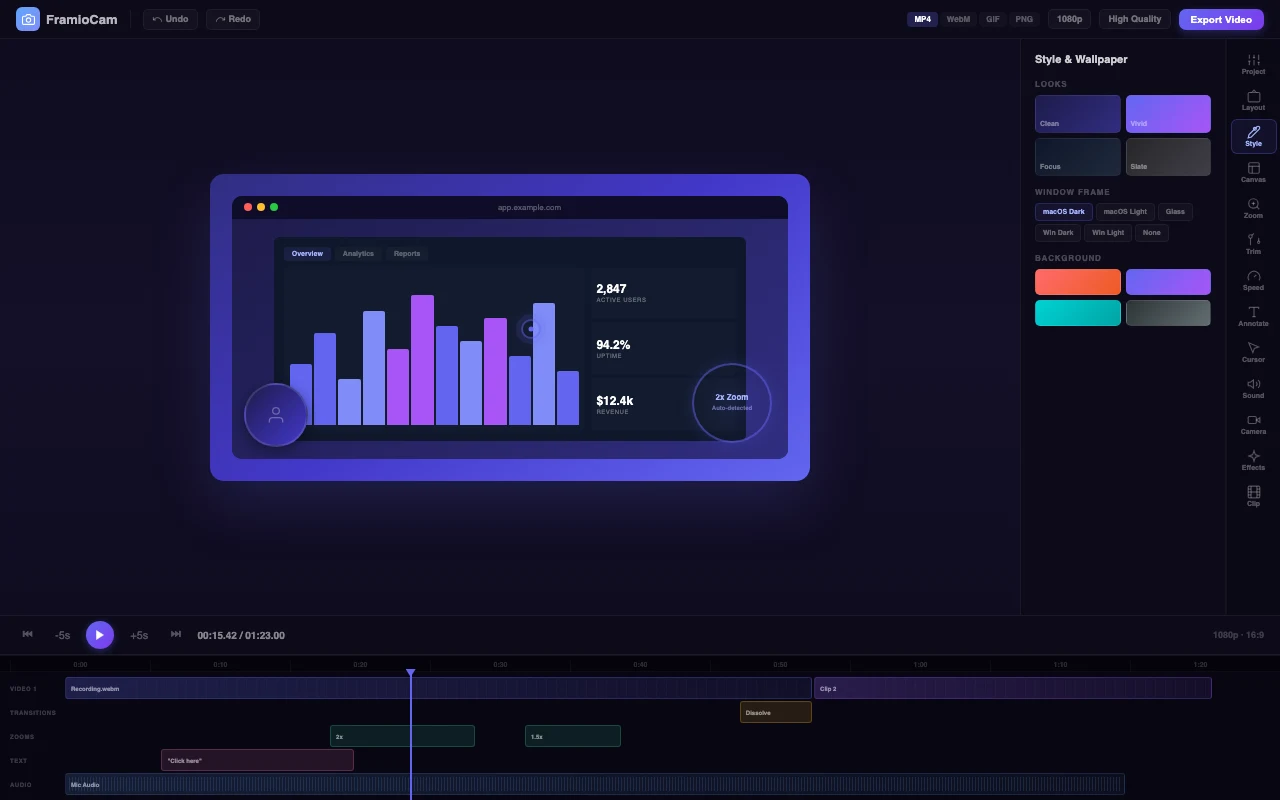
Screencastify’s paid tiers add watermark removal, basic editing, and interactive elements like questions and polls — useful for the classroom use case it’s built around. FramioCam’s video editor is a different category of tool: a multi-lane timeline with filmstrip thumbnails, split-and-ripple-delete, a 24-transition gallery with search and category tabs, zooms generated automatically from your actual recorded clicks, a cursor highlight ring, webcam compositing with independent shape/border/shadow controls, and text and audio lanes with their own timing. If the recording needs to be edited, not just trimmed to length, this is the real gap.
Screenshots aren’t really Screencastify’s job.
Screencastify is a screen recorder first; screenshot capture and styling aren’t part of its feature set the way they are for FramioCam. FramioCam treats both as one studio — the same backdrops, window-frame mockups, and watermark system apply to a still screenshot or a recorded video, so a screenshot and a clip of the same page end up looking like they belong together.
Where the file lives while you work.
Screencastify’s sharing model depends on uploading — that’s what makes “share instantly with a link” possible, and it’s a real convenience for the education use case it targets (teachers sending a lesson link to a whole class). FramioCam keeps capture, editing and local export in the browser. Pro and Teams can optionally send a file straight to the user’s own Google Drive; nothing is uploaded to FramioCam.
Where Screencastify is genuinely the better tool
- You’re in education. Screencastify’s classroom features — questions, polls, video requests and collection, LMS-style workflows — are purpose-built for that setting, and FramioCam has nothing comparable.
- Instant link-sharing to a large group is the actual requirement. Uploading once and sharing a URL to 30 students is simpler than distributing 30 files.
- You want interactive elements embedded in the video itself, like polls, which require a hosted platform to function.
Who FramioCam is actually built for
Teams outside the classroom use case — product managers recording a feature walkthrough, support engineers documenting a bug, course creators cutting lesson footage into chapters without needing a separate editor, and anyone who’d rather own a one-time licence outright than add another per-seat subscription line to the budget.
FAQ
Does Screencastify’s free plan really cap recordings at 30 minutes? Yes, and the free tier is limited to 10 videos total on top of that. FramioCam’s first 50 screenshots work without an account; a free account removes that limit. Recording length depends on device resources rather than a plan timer.
Can FramioCam do the classroom features Screencastify has, like polls? No. FramioCam doesn’t have interactive video elements or LMS-style distribution — it’s built for capturing and editing, not classroom delivery.
Is FramioCam cheaper than Screencastify for a small team? For up to three people, FramioCam’s three-person Teams licence is a one-time purchase. Screencastify’s Starter plan is $7/user/month when billed annually, or roughly $168/year for just two seats, recurring.
Does FramioCam upload recordings the way Screencastify does? No. Screencastify’s link-sharing depends on uploading to its platform. FramioCam captures, edits and exports locally; optional sync goes straight to your own Google Drive, with nothing uploaded to FramioCam.
See the full breakdown of how FramioCam compares to Screencastify, Loom, Scribe, CleanShot X and Awesome Screenshot, or add FramioCam to Chrome and try the first 50 screenshots free.